

Why Grounding Is Becoming Part of Modern Wellness
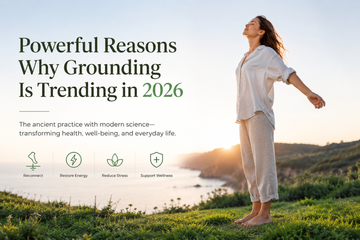
Something has shifted in the way people think about wellbeing.
As daily life becomes increasingly digital, indoor and fast-paced, many people are looking for simpler ways to reconnect with their bodies, their surroundings and the natural world. Grounding — the practice of making conductive contact with the Earth — has become part of that conversation.
Once considered a relatively niche wellness practice, grounding is now appearing more frequently in discussions around sleep, recovery, stress management and everyday routines.
But its growing popularity is not simply about following another wellness trend.
At its core, grounding reflects something much simpler: the desire to restore a form of connection that modern lifestyles often make easy to overlook.
01 — A return to something remarkably simple
For most of human history, direct contact with natural surfaces was part of everyday life.
People walked barefoot, worked outdoors and spent considerably more time in contact with the ground than many of us do today.
Modern environments have changed that relationship. Shoes, elevated buildings, synthetic flooring and increasingly indoor lifestyles mean direct contact with the Earth can now be relatively rare.
Grounding brings attention back to that simple connection.
Whether through walking barefoot outdoors or using conductive grounding products indoors, the principle remains the same: creating a conductive pathway between the body and the Earth.
02 — Sleep and recovery are becoming bigger wellness priorities
Wellness culture has also changed.
People are becoming less interested in simply doing more and increasingly interested in recovering better.
Sleep quality, nighttime routines, nervous-system regulation and recovery have become central parts of the modern wellness conversation.
That makes grounding particularly interesting because it can be incorporated into moments that already exist in the day — sitting at a desk, unwinding in the evening or resting in bed.
Instead of adding another complicated ritual, grounding can become part of an existing routine.
03 — Interest in grounding research continues to grow
Grounding has also attracted increasing scientific interest.
Published studies and review papers have explored grounding in relation to several areas of human physiology, including sleep, stress, circulation, recovery and inflammatory responses.
The existing research remains an evolving field, and more rigorous investigation is needed before broad conclusions can be made.
Still, the growing body of scientific literature has helped move grounding beyond purely anecdotal discussion and into a more serious conversation about how interaction with the Earth may influence human physiology.
REBANA believes this distinction matters.
Grounding should not be presented as a miracle solution. It should be explored thoughtfully — with curiosity, scientific perspective and realistic expectations.
04 — People are looking for more natural wellness routines
The rise of grounding also reflects a wider shift in wellness.
Many people are becoming more selective about complicated routines, endless supplements and highly optimized lifestyles.
Instead, there is growing interest in practices that feel more intuitive:
more daylight, better sleep, walking, time outdoors, slower evenings and greater connection with nature.
Grounding fits naturally within that philosophy.
It does not need to replace healthy sleep, movement, nutrition or medical care. Rather, it can exist alongside them as another way to create a more intentional relationship with rest and everyday wellbeing.
05 — Grounding has become easier to incorporate at home
One reason grounding has become more accessible is that it no longer requires spending hours barefoot outdoors.
Conductive products such as grounding mats and grounding sheets allow grounding contact to become part of ordinary indoor routines.
A grounding mat can sit beneath bare feet while working or relaxing.
A grounding sheet can integrate the same principle into the hours already spent resting in bed.
This ease of use has helped grounding move from something people occasionally experiment with outdoors into something that can become part of everyday life.
06 — Curiosity is replacing skepticism
Perhaps one of the biggest changes is simply that more people are willing to explore the idea.
Wellness consumers are increasingly comfortable asking two questions at the same time:
Could this be useful?
and
What does the evidence actually say?
That combination of curiosity and healthy skepticism is valuable.
Grounding does not need exaggerated promises to be interesting. Its simplicity, emerging research and connection with the natural environment already make it worth examining.
A more grounded way forward
Grounding may be gaining attention in 2026, but the idea behind it is anything but new.
It is ultimately about reconnecting with something that has always been beneath us.
For REBANA, that means approaching grounding with both openness and perspective — combining the simplicity of nature with a thoughtful understanding of the research.
Rest. Balance. Naturally.