

8 Research-Informed Ways Grounding May Support a Calmer Stress Response
Stress is part of everyday life.
In the right amount, it helps the body respond to challenges, stay alert and adapt to changing demands.
The problem begins when stress becomes persistent.
Long periods of psychological pressure, poor sleep, limited recovery and demanding routines can leave people feeling constantly switched on — mentally busy, physically tense and unable to fully unwind.
Grounding has been explored in a small but growing body of research looking at areas such as cortisol patterns, sleep, autonomic nervous-system activity, recovery and inflammatory processes.
That does not mean grounding is a treatment for anxiety, chronic stress or hormonal disorders.
A more useful question is whether grounding may fit into a broader routine designed to support rest, recovery and a calmer relationship with daily stress.
At REBANA, we approach the subject with both curiosity and realistic expectations.
Here are eight research-informed ways grounding may be relevant to the body's stress response.
Key Takeaways
• Cortisol is an essential hormone involved in the body's normal stress response.
• Some small grounding studies have explored changes in cortisol patterns, particularly during sleep.
• Grounding has also been studied in relation to autonomic nervous-system activity and heart-rate variability.
• Better sleep and more intentional recovery can influence how people respond to stress.
• Current grounding research remains limited and should not be interpreted as proof that grounding treats anxiety or hormonal disorders.
• The practical value of grounding may come partly from how easily it can fit into calm, repeatable daily routines.
Why Cortisol Matters
Cortisol is often described as the “stress hormone,” but that description is incomplete.
Cortisol plays many important roles in normal physiology.
It helps regulate:
• Energy availability
• Metabolism
• Immune activity
• Blood pressure
• Alertness
• The body's response to physical and psychological stress
Cortisol also follows a daily rhythm.
Levels generally change across the day as part of the body's circadian system.
That natural rhythm can be influenced by sleep, light exposure, illness, physical activity, psychological stress and many other factors.
Grounding research has explored whether conductive contact with the Earth may influence some of these patterns.
The findings are interesting, but the field is still developing.
1. Grounding Has Been Studied in Relation to Cortisol Rhythms
One frequently discussed area of grounding research involves cortisol.
A small study involving grounded sleep examined changes in nighttime cortisol patterns over several weeks.
Researchers reported changes in cortisol profiles in some participants, alongside subjective changes in areas such as sleep and stress.
This is worth exploring further.
However, a small study cannot establish that grounding “resets cortisol” or corrects hormonal dysfunction.
Cortisol regulation is complex and influenced by many factors.
A more accurate conclusion is that grounding has been investigated as one possible influence on daily stress-related physiology.
2. Grounding Has Been Explored in Relation to Autonomic Nervous-System Activity
The autonomic nervous system helps regulate many processes that happen without conscious effort.
It includes systems involved in activation, recovery, digestion, heart rate and other automatic functions.
Stress is often associated with greater sympathetic activation — commonly described as the body's “fight or flight” response.
Recovery is associated more closely with parasympathetic activity.
Some grounding studies have measured physiological signals related to autonomic activity, including heart-rate variability.
These findings have encouraged researchers to ask whether grounding may influence how the nervous system shifts between activation and recovery.
The evidence is not strong enough to claim that grounding automatically “switches off” the stress response.
But nervous-system regulation remains a relevant area of study.
3. Grounding Research Has Explored Inflammatory and Oxidative Processes
Stress and inflammation can interact in complicated ways.
Persistent psychological and physiological stress can influence immune signaling, recovery and inflammatory activity.
Grounding literature has proposed that conductive contact with the Earth may interact with oxidative and inflammatory processes.
Some studies have measured inflammatory markers in grounded participants.
These findings are interesting but should be interpreted carefully.
It would be too strong to say that grounding removes inflammation or directly lowers stress hormones by neutralizing free radicals.
The mechanism remains under investigation.
For now, the reasonable conclusion is that inflammatory physiology is another area where grounding has generated scientific interest.
4. Heart-Rate Variability Has Been Studied as a Marker of Physiological Regulation
Heart-rate variability, often abbreviated HRV, describes variation in the timing between heartbeats.
It is frequently used in research and wellness settings as one indicator associated with autonomic regulation and recovery.
Some grounding studies have explored HRV and reported measurable changes during grounded conditions.
That does not mean a higher HRV score is guaranteed after every grounding session.
HRV is influenced by many things, including:
• Sleep
• Exercise
• Alcohol
• Illness
• Psychological stress
• Breathing
• Training load
• Age
Still, the fact that grounding has been studied using objective physiological measures makes this area worth following as the research develops.
5. Grounding May Fit Naturally Into Stress-Recovery Routines
There is also a practical reason grounding can make sense in a stress-management routine.
It is easy to pair with activities that already encourage slower behavior.
For example:
• Sitting quietly outside
• Reading
• Drinking tea
• Stretching
• Relaxing after work
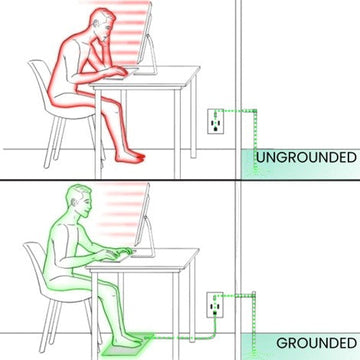
• Working at a desk with a grounding mat beneath bare feet
• Resting in bed with a grounding sheet
The grounding itself is only one part of the experience.
Slowing down, reducing stimulation and allowing time for recovery may also contribute to how someone feels.
That does not make the routine less valuable.
It simply means we should be careful about attributing every subjective change to one mechanism.
6. Grounding Has Been Studied in Relation to Sleep
Sleep and stress influence one another strongly.
Stress can make it harder to fall asleep.
Poor sleep can then make the following day feel more stressful.
Grounding research has included nighttime use, and some studies have reported changes in sleep-related outcomes.
This may be especially relevant for grounding sheets because they allow contact to occur during hours already dedicated to rest.
However, grounding should not replace the foundations of good sleep.
Those still include:
• Consistent sleep timing
• Appropriate light exposure
• A comfortable bedroom
• Managing caffeine and alcohol
• Regular movement
• Allowing enough time for sleep
• Seeking professional help for persistent sleep problems
Grounding may complement these foundations.
It should not substitute for them.
7. Objective Physiological Changes Have Been Explored in Different Populations
Grounding researchers have examined physiological responses in different groups, including healthy adults and other specific populations.
Some studies have reported measurable changes in autonomic or cardiovascular-related markers during grounded conditions.
These findings are one reason grounding remains scientifically interesting.
At the same time, results from one population cannot automatically be applied to everyone.
A finding in a small experimental group does not prove that grounding will reduce stress in every person who uses a mat or sheet.
Larger, independent and well-controlled studies are still needed.
8. Grounding Can Be Easy to Repeat Consistently
One of grounding's most practical strengths is simplicity.
Many stress-management strategies fail not because they are ineffective, but because they are difficult to maintain.
Grounding can fit into routines people already have.
At a desk:
Place a grounding mat beneath bare feet while working.
During an evening routine:
Use a mat while reading or relaxing.
At night:
Use a properly connected grounding sheet as part of the sleep environment.
Outdoors:
Spend time barefoot on an appropriate natural surface.
There is no need to turn grounding into another complicated wellness program.
Consistency becomes easier when the practice does not require extra time, equipment changes or a separate appointment in the day.
Grounding and the HPA Axis
The hypothalamic-pituitary-adrenal axis, often shortened to HPA axis, plays a central role in the body's stress response.
When the brain perceives a challenge, hormonal signaling helps coordinate the release of cortisol and other stress-related compounds.
This system is essential.
The goal is not to eliminate the stress response.
Rather, healthy physiology involves being able to respond when needed and recover afterward.
Grounding has sometimes been discussed as a possible influence on stress-related regulation.
But current evidence is not strong enough to say that grounding directly “repairs” or “resets” the HPA axis.
That language goes beyond what research can currently demonstrate.
A more responsible view is that grounding may interact with several physiological systems related to recovery, and these relationships deserve further study.
What Grounding Cannot Promise
Grounding should not be marketed as a cure for:
• Anxiety disorders
• Depression
• Adrenal disorders
• Hormonal imbalance
• Chronic stress-related disease
• Insomnia
• Inflammatory disease
These conditions can involve complex medical, psychological and lifestyle factors.
If persistent stress is interfering with sleep, work, relationships or daily life, professional support may be appropriate.
Grounding can exist alongside evidence-based care.
It should not replace it.
How to Build Grounding Into a Calmer Routine
If you want to experiment with grounding, begin with something simple.
Morning
Place a grounding mat beneath bare feet while having coffee, reading or beginning your workday.
During Work
Keep the mat under your desk so grounding contact happens without requiring another separate routine.
After Work
Use grounding as part of a transition period between work and evening.
This could include reading, stretching or sitting quietly.
Before Bed
Use a mat while winding down or incorporate a grounding sheet into your sleep environment.
Outdoors
Spend time barefoot on an appropriate natural surface when weather and environment make that practical.
You do not need to do all of these.
Choose the version that fits most naturally into your life.
The Bigger Picture of Stress Management
Grounding can be one small part of a broader stress-management approach.
The fundamentals remain more important.
Prioritize:
• Consistent sleep
• Regular movement
• Time outdoors
• Appropriate nutrition
• Social connection
• Recovery between demanding periods
• Breathing and relaxation practices
• Professional support when stress becomes persistent or overwhelming
Grounding may complement these habits.
It should not carry the burden of replacing them.
Conclusion
Grounding research has explored several physiological areas connected with stress and recovery, including cortisol patterns, autonomic nervous-system activity, heart-rate variability, sleep and inflammatory processes.
Some findings are promising.
But the evidence is not strong enough to claim that grounding reliably reduces stress hormones, treats anxiety or corrects hormonal dysfunction.
For REBANA, the value of grounding lies in a more balanced possibility:
It is a simple practice that can bring natural connection into moments already dedicated to work, rest and recovery — while scientific research continues to explore what that connection may mean for human physiology.
Keep the routine simple.
Keep the expectations realistic.
Rest. Balance. Naturally.
FAQs
Does grounding reduce cortisol?
Some small studies have explored grounding in relation to cortisol patterns and reported changes in certain participants. More research is needed before grounding can be said to reliably reduce cortisol.
Can grounding help with stress?
Grounding has been studied in relation to physiological systems involved in stress and recovery. Individual experiences vary, and grounding should be viewed as a complementary wellness practice rather than a treatment for chronic stress or anxiety.
How long should I ground for stress?
There is no scientifically established universal duration. Choose a period that fits naturally into your routine and focus on consistent use rather than an exact number of minutes.
Can I use a grounding mat while working?
Yes. A mat beneath bare feet at a desk is one of the simplest ways to integrate grounding into a daytime routine.
Can I use a grounding sheet at night?
Yes. Grounding sheets are designed to integrate conductive contact into the hours already spent resting, provided they are connected and used according to their instructions.
Is indoor grounding the same as going barefoot outdoors?
Both are designed around conductive contact with ground, but the exact pathway and environment differ. Indoor products should always be set up according to their specific instructions.
Can grounding replace treatment for anxiety or chronic stress?
No. Grounding should not replace professional care, medication, therapy or other evidence-based treatment when those are needed.